Desertscope

Musings from Southern New Mexico

Page 59 of 60

Fox Geezer Syndrome

Former Bush Jr. speechwriter David Frum over at FrumForum is posting some of the “Best of” from his site this year. I thought by FF contributor Richmond Ramsey sounded awfully familiar. My parents are not so much this way, but I know a number of members of their generation for whom this is spot-on:

… it turns out that our folks have all been sitting at home watching Fox News Channel all day – especially Glenn Beck’s program.

I don’t know when it happened, exactly, but she began peppering our conversation with red-hot remarks about President Obama. I would try to engage her, but unless I shared her particular judgment, and her outrage, she apparently thought that I was a dupe or a RINO. Finally I asked my father privately why Mom, who as far as I know never before had a political thought, was so worked up about Obama all the time.

Many of my co-workers in their mid 50s or later have begun to develop this personality trait. I had never thought that the trend extended across the nation. Perhaps I was wrong. I wonder how historians of the future will look back on the media of the early 2000s.

Nearly Done with Christmas

After completing all the necessary Christmas-related decorating, shopping, travel, and cultural crap, we had only one small thing left to do. We were to host a small dinner party. Everything had been timed perfectly, and I was just about ready to serve. As I pulled the Roast Beast from the oven, I threw out my back. So I suffered through dinner and after-dinner conversation trying my damnedest to grin through clenched teeth. On the rare occasion when this happens, I am reminded that old age is going to suck. Getting into and out of bed (or, for that matter, the car) can take minutes. I went to work yesterday, but the pain kept me from doing much. I went for a run after work, hoping it would provide a reprieve from the pain. It worked. Of course, after I had stopped running and sat down, the pain returned with a vengeance. So now I am laying prone on the living room floor, burning off a day of sick leave without enjoying it. On the plus side, we all survived Christmas without a hitch.

On Hitchens

Lindsay Beyerstein has collected what she calls Four Antidotes to Hitchens Hagiography.  I understand the anger at how so many members of the media have bent over backwards to sing his praises.  I acknowledge his jingoistic bent, his cruel streak, his drunkenness, and his misogyny.  Those character flaws do not make his brilliant prose any less correct when it is correct.  For that matter, the brilliance of his prose doesn’t make his invalid arguments any more valid.  We should look at each claim according to its own merits.

I read Hitchens’ God is Not Great and thought it was a fantastic book.  In addition to his formidable pen, he is a wonderful speaker and debater.  I cannot defend all of his many faults, but I do have a statement on that.  I thought of this post I wrote last fall after P.Z. Myers had the gall to quote H.P. Lovecraft:

I saw this quote up at Pharyngula yesterday.

As for the Republicans — how can one regard seriously a frightened, greedy, nostalgic huddle of tradesmen and lucky idlers who shut their eyes to history and science, steel their emotions against decent human sympathy, cling to sordid and provincial ideals exalting sheer acquisitiveness and condoning artificial hardship for the non-materially-shrewd, dwell smugly and sentimentally in a distorted dream-cosmos of outmoded phrases and principles and attitudes based on the bygone agricultural-handicraft world, and revel in (consciously or unconsciously) mendacious assumptions (such as the notion that real liberty is synonymous with the single detail of unrestricted economic license or that a rational planning of resource-distribution would contravene some vague and mystical ‘American heritage’…) utterly contrary to fact and without the slightest foundation in human experience? Intellectually, the Republican idea deserves the tolerance and respect one gives to the dead.

It is a brilliant quote, I thought. According to one commenter, it was cited as August 1936, Letter to C.L. Moore, August 1936 quoted in “H.P. Lovecraft, a Life” by S.T. Joshi, p. 574.

I was rather amazed at the vitriol spewed forth. Most of the comments seemed to be absorbed in the fact that H.P. Lovecraft was a racist bigot. Should we, then, eradicate the works of Nobel Laureate and DNA co-discoverer James Watson? He’s a racist, sexist asshole. Certainly, then, his ideas on genetics are rendered invalid. Mel Gibson is an antisemitic drunk, therefore anyone who watches the movie Gallipoli is an antisemitic drunk. The Pythagoreans were a mystical cult, so no rationalist should accept that the square of the hypotenuse of a right triangle is equal to the sum of the squares of the other two sides.

I suppose my point is that if one agrees with Mr. Lovecraft’s assessment of the Republican Party’s basic tenets, then he should feel free to avail himself of the eloquent quote. There are a number of reasonable quotes on statecraft to be found in the writings of some of the most despicable characters in history. To the dirty hippies that are bitching about Myers’ use of the quote, do you really think every person you dislike is always wrong?

All that was said there goes as well for the writings of the late, great Christopher Hitchens.

Review: Three Kingdoms: A Historical Novel

As I mentioned yesterday, I have finally finished the Chinese epic:
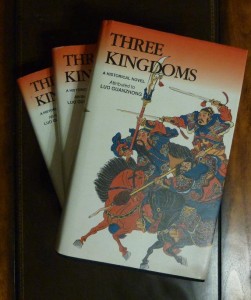

Three Kingdoms:  A Historical Novel  (三国演义)
attributed to Luo Guanzhong  (罗贯中)
Translated by Moss Roberts
1690 pages
Foreign Language Press, Beijing,1994

The pages had begun to yellow with age before I finally picked up this, the great classic of the waning years of the Han dynasty. At fourteen and a half years, this tome has held its secrets longer than any other work on my shelves.

Here begins our tale. The empire, long divided, must unite; long united, must divide. Thus has it ever been.

The Emperor has fallen under the influence of corrupt officials.  While performing ancestral rites, the courtiers witness omens, the likes of which will become key features in the story. The Yellow Scarves Rebellion breaks out, sending the Empire into turmoil. Imperial powers are usurped by ambitious officials, leaving the Emperor a virtual prisoner. The Empire would eventually be fractured into three separate kingdoms.

The story unfolds with a Peach Garden Oath wherein three heroes pledge brotherhood. The eldest brother, Liú Bèi (刘备), is a relative of the imperial family.  His brothers would help him in the struggle to restore the Han dynasty. The third brother, Zhāng Fēi (张飞), is of fierce visage and terrible temper. While you may have seen these two depicted in paintings, you have almost certainly seen the second brother, Guān Yǔ (关羽). He is depicted with a flowing beard, carrying a great halberd known as the Green Dragon Crescent Blade. The Peach Garden Oath and the three brothers would become ubiquitous in East Asian art and literature for centuries. Liú Bèi, Sūn Quán (孙权), and Cáo Cāo (曹操), would come to found three separate kingdoms. Each (or his progeny) would eventually declare himself Emperor.

The reader is introduced to the great warriors from Lǚ Bù (吕布), to Mǎ Chāo (马超), the crafty villain in Cáo Cāo, the brilliant strategist in Zhūgě Liàng (诸葛亮), and a vast array of characters known throughout East Asia. From several vignettes, the reader can see how profoundly Eastern philosophy differs from Western philosophy. Murder, sacrifice, betrayal, loyalty, torture, humanity, and all the trappings of political intrigue are seen as the the fortunes of the three kingdoms ebb and flow.

The events depicted take place from C.E. 168 to 280. This is a true epic in the grandest sense of the word. In the forward, John S. Service describes traveling through China during the war with Japan. Therein, he finds his traveling colleagues excitedly pointing out events from Three Kingdoms, denoting the difference between this novel and Western epics. This one is real. Covering an area larger than Europe, the leaders and battles in the book reflect events and people drawn from history, rather than fantasy. I should say it it mostly not fantasy. As is to be expected of books of ancient times, an unsettling amount of superstition and wizardry mars the pages. These sojourns into astrology, and magic do not generally amount to much more than plot points, but the author does take pains to punish any skeptics or naysayers ironically. Aside from the magic, the translator informs the reader of the uncertain pedigree of the complete work. How much is historical and how much is real? We will certainly never know. Gazing back longingly at the sepia-toned days of yore is apparently an ancient and universal pastime.

The text is laced with poetry written in the centuries after the events took place, expounding on the ideals representing a mixture of Confucian and Daoist philosophy with a reverence to the past. The more I read, the more important I found it in understanding the modern Far East.

In the notes, the translator lists over one hundred major characters. For each major character, there are several minor characters. This, in addition to the number of place names gives reason for intimidation in the reader. The afterward and notes amount to an astonishing 231 pages.

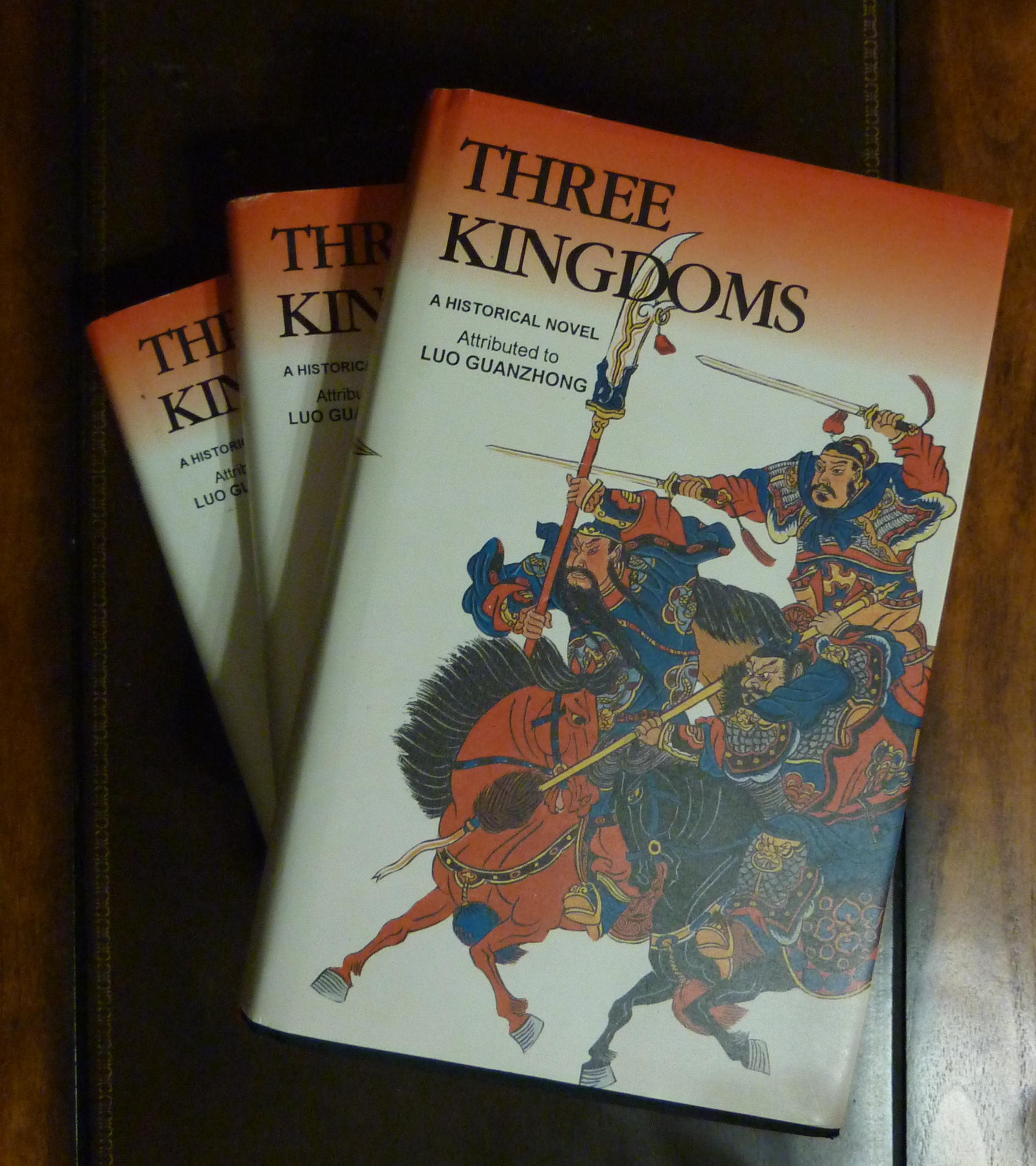
Three Kingdoms

In June of 1997, I was in Beijing.  It was a few days before Hong Kong was transferred from the United Kingdom to China, and I bought this three-volume set:

I finally started reading it last month.  I finished it a few minutes ago.

« Older posts Newer posts »

© 2026 Desertscope

Theme by Anders NorenUp ↑