I doubt I have enough focus for entries longer than 140 characters. Thanks for giving me the attention span of a 4 year old, Twitter.
Page 25 of 60
I have been increasingly distracted by that most terrible of current social media beasts, Twitter. One unfortunate side effect is a near absence of other online production. I will try to remedy that.
I took a screen capture of a symptom of the pathology of our current media environment.
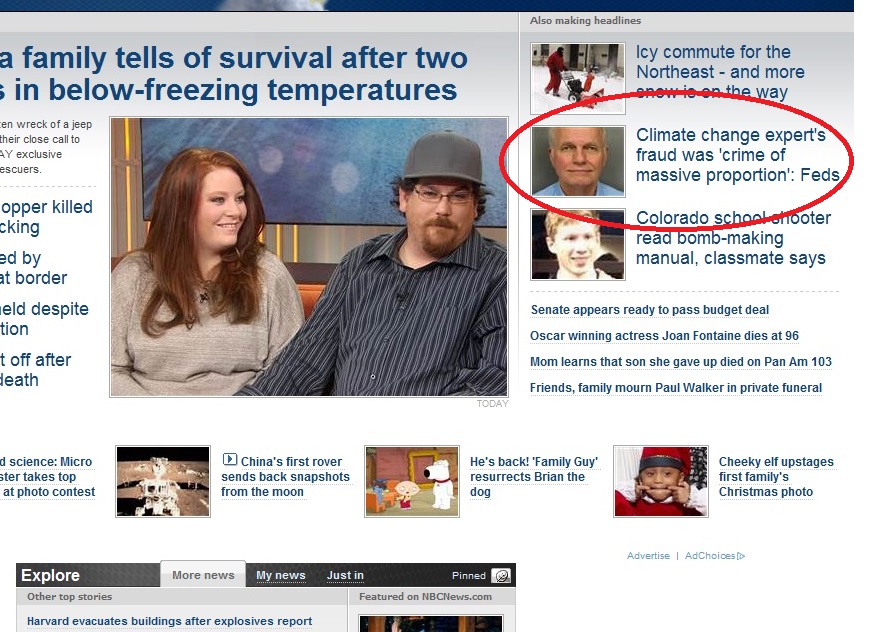
What’s the implication here?
The story here is of a man, John Beale, who was serving as a top EPA official. His job description included expertise in the science of climate change. Rather than doing that job, however, he managed to convince his employer that he was secretly working for the CIA. He racked up hundreds of thousands of dollars in travel expenses and collected a salary while doing little actual work.
What does this have to do with climate science?
Nothing.
But don’t let that stop you from writing a headline implying that climate science is a fraud. In our mediascape, creating a false impression is desirable if it earns clicks.
In the community, UAVs are not the same as drones. Drones are unmanned targets. Drones are designed to be shot down. The unmanned aerial vehicle or UAV is mean to be used over an extended period of time. Since someone is apparently employed full time at the Pentagon with the sole task of creating unnecessary abbreviations, UAVs are now also known as UASs (unmanned aerial systems) or RPVs (remotely piloted vehicles).
Anyway…
Some large UAVs, such as the Predator, are extremely reliable. That is to say, they have a mean time between failures of thousands of flight hours. These cost four millions dollars apiece. Of course, “reliability” is relative. A passenger jet is expected to have a mean time between failures of millions of flight hours. UAVs and passenger aircraft, you see, are held to very different standards. Note, as well, that the pictures provided by Amazon show UAVs much smaller than the massive and expensive military UAVs. In the UAV world, reliability tends to scale down with size.
The image invited by the headlines is of a rotary-winged aircraft dropping down to your front lawn cradling Aunt Zelda’s Christmas cookies in a bow-bedecked box. With this in mind, I think I’ll write down the first five objections that come to mind:
First, what fraction of the population lives in a place that could easily be reached without hazard to or from overhead power lines, trees, or transmission towers?
Second, surface winds and weather in general are extremely important to low flying aircraft, especially the small variety. Is there a vast real-time weather grid operating at the 100 meter scale across the nation that I don’t know about?
Third, any UAV large enough to carry cargo and with enough range to be useful will produce lethal debris when (not if) it fails mid-flight.
Fourth, an enormous hazard that would be posed by thousands of vehicles. In order to make this venture profitable, the government would have to preemptively absolve the carrier of any liability for the deaths and damage to property that would inevitably result.
Fifth, there is a reason we never got the jet packs and flying cars we were promised decades ago. Those things are not economically feasible. A vehicle to cargo mass ratio of 100 to 1 may work with ground vehicles, but I really doubt it would work with any rotary-wing aircraft.
And any of dozens of other questions follow, about protection from the elements, signing for packages, ethics of surveillance, reliability of operators, right wing loons shooting them from the sky, and the list goes on. But I think you get the idea.
In conclusion, this is farce masquerading as science fiction. Any government official unscrupulous enough to sacrifice public safety in favor of corporate profit would be … well, to be fair, would be just about any political appointee confirmed by the Senate in the last couple of dozen years.
But regardless of the abrogation of the public trust this entails, it is a crackpot idea. I have only ever heard of one crackpot who succeeded in technology: Guglielmo Marconi.
But that is another story (see Erik Larson’s excellent book, Thunderstruck).
A couple of decades ago, a person who gained employment working with top secret documents with the intent of stealing and distributing those documents to America’s adversaries would have been called a spy.
Of course your modern Libertarian doesn’t see it that way. Since the government is now run by one of those people, if you know what I mean, espionage isn’t really that big a deal.
Google doesn’t help me narrow down the originator (that is, there are too many possible original sources), but I have read in many places something like, “Scratch the surface of a Libertarian, and you find an authoritarian.”
Here, libertarians bestow the title of “whistleblower” on a person whose actions certainly meet the definition of premeditated espionage. To many libertarians any damage done to the United States of America is worth it, so long there is harm done to the administration of that … person. Thus does a person that would otherwise be considered just another privileged asshole get to live out a fantasy in which foreign governments allow him to pretend to be some sort of hero while under complete control so long as he continues to provide damaging information.
All because that person didn’t mind his place…
Recent Comments