Musings from Southern New Mexico

Author: marc (Page 55 of 60)

I am a scientist interested in laser safety, modeling and simulation, and statistics.

I speak some Spanish, German, and Chinese.

Mindset

From the book Bounce: Mozart, Federer, Picasso, Beckham, and the Science of Success by Matthew Syed, I got turned on to Mindset: The New Psychology of Success by Carol Dweck. Her thesis is that we have two basic mindsets that she calls “fixed” and “growth.” I am always a little leery about binary divisions, particularly in something as complex as human psychology. Nevertheless, I find much of what she says very compelling. Dweck’s so-called “growth” mindset leaves individuals open to expansion and promotes the idea of hard work. The “fixed” mindset, on the other hand, is characterized by a reliance on real or perceived talent. In a variety of experiments covering a broad range of tasks, an obvious pattern emerged. Subjects who were led to believe they were particularly talented underperformed thereafter, while subjects complimented on the amount of effort they had put in tended to overperform.

As I was reading through right-wing nuttery lately (I have odd hobbies), I hit on a sort of epiphany. I wonder to what extent Dweck’s “mindset” idea explains our current national character. Where most of the developed world was left devastated by the end of World War II, the United States was relatively unscathed. I think few would doubt the worth of the generation of Americans that survived the Great Depression and emerged from the second World War an economic juggernaut. Those who grew up in the post-war years, however, embraced the concept of American exceptionalism. The baby boomers have made this country into that coddled brat who has been told of his greatness since childhood. Meanwhile, the real assets of this nation are forgotten. Disagree? Who listens to Rush Limbaugh and, in the 21st century, is still frightened of “socialism,” women, and dark people? I rest my case.
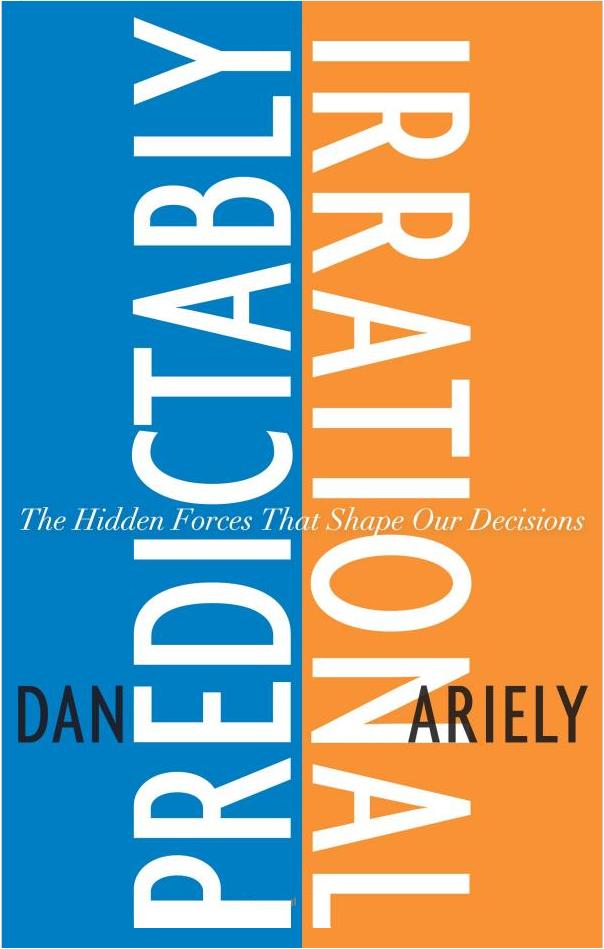
Review: Predictably Irrational

Predictably Irrational

Predictably Irrational

Predictably Irrational
The Hidden Forces that Shape Our Decisions
by Dan Ariely
400 pages
Harper Collins, New York, 2008

This book is an interesting treatment of a topic with which I had been entirely unfamiliar. The author introduces the subject by considering his experiences while undergoing the painful treatments necessary for burn victims. While this personal story doesn’t seem to be overtly on topic, it seems that that is actually the root of this book. As the subtitle suggests, we are often slaves to the little things going on in the background of the mind. Behavioral economics appears to be a mix of psychology and the economy of the small scale. What makes the subject interesting is that the author and his team use small experiments to test theories of the sort that one may have independently imagined. Ariely extrapolates from these little experiments to more general meaning for human behavior.

Unfortunately, most of economics seems to negate the majority of naive right wing theories. I think some people could take the author’s translation of his findings into macroeconomics as “another sign of liberal bias,” but the neutral observer will find the evidence presented readily supportive of his claims. A notable exception to seeming liberal bias of economic reality is that the author’s research shows a specific improvement in honesty immediately following a particular religion-based exercise. As distasteful as I find this, I can certainly believe that certain people are more well behaved under threat of eternal damnation.

This is a topic I suddenly find fascinating. I will certainly be reading more on this in the future. I will let Ariely close out with his own words:

Standard economics assumes that we are rational, that we know all the pertinent information about our decisions, that we can calculate the value of the different options we face, and that we are cognitively unhindered in weighing the ramifications of each choice. The result is that we are presumed to be making logical and sensible conclusions. And even if we make a wrong decision from time to time, the standard economics perspective suggests that we will quickly learn from our mistakes, either on our own or with the help of market forces. On the basis of these assumptions, economists draw far-reaching conclusions about everything from shopping trends to law to public policy. But as the results presented in this book and others show, we are all far less rational in our decision making than standard economic theory assumes. Our irrational behaviors are neither random nor senseless. They are systematic and predictable.
…
Wouldn’t economics make a lot more sense if it were based on how people actually behave instead of how they should behave?

I think that tidily sums up the book.

The Heartland Institute

When the news first broke on this, I was reminded of something I had read about a year ago. I wrote a review of that great but disturbing book called Merchants of Doubt by Naomi Orekes and Erik M. Conway. I looked up the connection and found this on the the Wikipedia listing of the Heartland Institute:

In Merchants of Doubt, Naomi Oreskes and Erik M. Conway wrote that the Heartland Institute was known “for its persistent questioning of climate science, for its promotion of ‘experts’ who have done little, if any, peer-reviewed climate research, and for its sponsorship of a conference in New York City in 2008 alleging that the scientific community’s work on global warming is fake.”

Yes, this is indeed one of those organizations. I thought it might be worth restating my point from that review:

If the people can be led to believe that science is not, in general, trustworthy, then they can be convinced of any absurdity that favors a wealthy industry.

This book will be extremely disturbing for all scientists and followers of science. It is disturbing to all scientists, that is, who aren’t willing to prostitute their credentials out for personal gain.

I wish a scientist could have his (to be expected perhaps, the vast majority of deniers are male) credentials revoked for malpractice in the same manner as a physician.

My Reading Lately

I have been really bad lately about reviewing books that I read. It’s not really a big deal, as I basically do it to help me retain whatever it was I was reading about. Of course, it is also to complain about crappy books when possible. Unfortunately, I have been so busy lately that I don’t even recall how many books I’ve read without writing anything on them. So I guess this is my attempt at addressing the heretofore unmentioned books I’ve read in the past few months:

  • Crossroads of Freedom: Antietam by James M. McPherson
  • The River of Doubt: Theodore Roosevelt’s Darkest Journey by Candice Millard
  • Sleights of Mind: What the Neuroscience of Magic Reveals About Our Everday Deceptions by Stephen L. Macknik and Susana Martinez-Conde with Sandra Blakeslee
  • Extreme Fear by Jeff Wise
  • Landscape Turned Red: The Battle of Antietam by Stephen W. Sears
  • Misquoting Jesus by Bart D. Ehrman
  • In a Sunburned Country by Bill Bryson
  • Frauds, Myths, and Mysteries: Science and Pseudoscience in Archaeology by Kenneth L. Feder
  • The Science of Fear: Why We Fear the Things we Should Not – and Put Ourselves in Great Danger by Daniel Gardner
  • Bounce: Mozart, Federer, Picasso, Beckham, and the Science of Success by Matthew Syed
  • The Tipping Point: How Little Things Can Make a Big Difference by Malcolm Gladwell
  • Update:I forgot I also just read Numbers Rule Your World by Kaiser Fung
  • What I’m currently reading:

  • How to Think about Weird Things: Critical Thinking for a New Age by Theodore Schick, Jr. and Lewis Vaughn
  • Mindset: The New Psychology of Success by Carol Dweck
  • Memoirs of General William Tecumseh Sherman by William T. Sherman
  • Predictably Irrational: The Hidden Forces That Shape Our Decisions by Dan Ariely
  • Someday maybe I’ll get around to reviewing some of these.

    Hmmm. On looking at this list, one might get the idea that my major interests are the American Civil War and behavioral economics. Odd, as I never really thought of that…

    Trashy Pseudojournalism of a Bygone Era

    I have the mind of a juvenile, so I occassion the virtual pages of Cracked magazine. One of my favorite writers there is a bemohawked (orange, no less) enthusiast of comic books, various fighting sports, and truly awful literature. He had an article out today on one of the terrible magazines that apparently used to exist. You can see it here. After stepping through the article, I began to get an image in my head. I know of something that so resembles this drivel from years past. Only now, instead of the production values associated with a niche publication, a modern global corporation runs this material with no expense spared to present it as actual journalism rather than what it is. The misogyny, racism, obsession with violence, fear-mongering, and sensationalist headlines are all hallmarks of the Rupert Murdoch’s media empire. Yes, Fox is the trashy dime-store “men’s magazine” of the 21st Century.

    « Older posts Newer posts »

    © 2026 Desertscope

    Theme by Anders Noren — Up ↑